How it works · idea to live app
Describe it. Publish it. It runs in the thread.
No SDK, no app store review, no six-month integration with a carrier. Bring an idea in whatever form you already have it, and have a real branching conversation running on a real handset the same day. Then connect it to everything you own.
The channel nobody has been able to build on
Almost nobody is building here yet. Because it has been too hard.
Not because it does not work. Because the door has been shut. Carrier programs, brand verification, sender provisioning, infrastructure, and no builder tooling worth the name — the price of entry was an integration team and a year, so only the giants went through it. Somebody had to build the on-ramp. Nobody did. That is what this is — we are the first real gateway. Same networks, same verified-sender status, without the year.
The carrier side is already done: we partner with Infobip as the gateway, so brand verification, global reach and deliverability are handled by people who do it at planetary scale. One contract, one API, and you arrive as a verified sender — your name, your logo, a checkmark at the top of the thread. The hard part is already done. The part that is left is the idea.
And there is a fair objection waiting: we already spent the budget on the app and the website. Good — keep them. This is not a replacement for either, it is the zero-friction front door that feeds them. Scan a code, start a conversation, get the thing done in the thread, and land in your app for the part that deserves an app. No download to begin. Nothing to install before value.
The other half of why it stayed hard is subtler. The teams that did try reached for a send API, bolted an AI on top, and hoped. Put the same person in front of the same AI twice and you get two different conversations, two different endings, and two different piles of data — because nothing told the AI what it was building toward. That is not a model problem. It is a target problem.
Workflows are the rails
You design the steps once — the questions, the branches, the photos, the signature, the validation. That structure is what Apple Messages for Business expresses: suggested replies, rich cards, multi-select carousels, a real back-and-forth with state. The same workflow runs on Apple Messages for Business, WhatsApp, the mobile app, a tablet, a laptop — and Alexa next. The workflow is the app. The channel is just where it runs.
And they are the target for the AI
Now the conversation can wander wherever a human wants to take it, because the AI has something it must land: the workflow has to complete. Every answer is mapped to a step, every step is validated, nothing is invented. The talk is free-form. The data is not. Same structured result every single time, whether it took four taps or one long spoken paragraph.
The conversation is free. The outcome is guaranteed.
01 · Describe it
However you already have the idea.
A PDF of the returns policy. The intake form your team emails around. A flowchart, a whiteboard photo, a napkin. Or one sentence: “let a customer return an item, pick a reason, photograph it and get a QR code.”
The AI reads it — the fields, the rules, the order, the branches — and produces a real workflow. Not a mock-up. Something you open on your own phone.
01b · Or don't describe it at all
Point your AI at us.
Connect Claude, ChatGPT, Replit, Cursor or your own agent to /mcp with your API key. It reads the documentation itself, learns your data model, and builds the whole thing while you do something else.
Every capability is a plain REST endpoint and a typed AI tool — one engine, two front doors. Whatever an agent can do here, you can do by hand, and the reverse.
One thing to know before you start, whichever way you build: you are not wiring up a send API. You are authoring a workflow and publishing it — and the channel is only where it runs.
02 · Design the conversation
Where everyone else stops at send, wait, follow up.
A dozen providers will deliver an RCS message for you, and their journey builders are marketing sequences. None of them orchestrates work. This one does, and it is the difference between a nicer newsletter and an application that happens to live in a thread.
Parallel paths
Let a person take the legs in any order they like and still finish everything required. Patent pending, and nobody else offers it.
Branch on who they are
The conversation adapts to this customer, this order, this tier, this location — from your live data, not a hardcoded fork.
Loops, approvals, signatures
Repeat per item, escalate for sign-off, capture a real signature. The controls an actual process needs.
Validated capture
Photos, files, location, dates, numbers with ranges. Answers come back typed and checked, not as loose text.
Memory across sessions
They leave and come back tomorrow. The thread knows where they were and what they already told you.
Kits, not one-offs
Compose several workflows into one branded experience — returns and reorders and loyalty as a single place, not three campaigns.
03 · Connect it to everything you own
A conversation is only as good as what it knows.
Sync from your ERP, OMS, CRM, PIM or warehouse — a packaged platform, any web API, or your own SQL Server or Postgres, which is the deepest integration available anywhere because it is your schema and you already own it. Live product data, real order history, actual entitlements.
Then every tap becomes an event the moment it happens: fire a webhook, call your API, start the next workflow, page a human, or hand the thread to an AI agent. Structured and validated, not a transcript somebody has to read.
Zapier waits for your software to do something. We wait for your customer to.

In from your systems, back out as events
04 · Launch it
Write it once. It arrives native everywhere.
Author the intent once — a question, a choice, a card, a carousel, a location ask, a payment — and each channel renders it in its own real shape. RCS rich cards and suggested replies. Apple Messages for Business. WhatsApp interactive. Plain SMS when that is all there is. Add a channel next year and nothing you built changes.
Launch it with a link, a QR code on a receipt or a poster, a keyword, or straight from your own system. Every scan and every run is tracked back to the campaign that produced it.
The part nobody expects
A workflow that runs with the phone away.
This is business messaging you never look at. Wingman reads the step into a Bluetooth earpiece and captures the spoken answer — the same published workflow, the same validation, the same structured result, with the handset in a pocket.
Anyone whose hands are busy: a warehouse picker, a driver between stops, someone on a retail floor or an events crew or a clinical round. One sentence can fill a dozen fields at once, and anything still owed — a photo, a signature — is tracked until it is cleared.
The voice is the interface. The texts — and the data behind them — are the receipt.
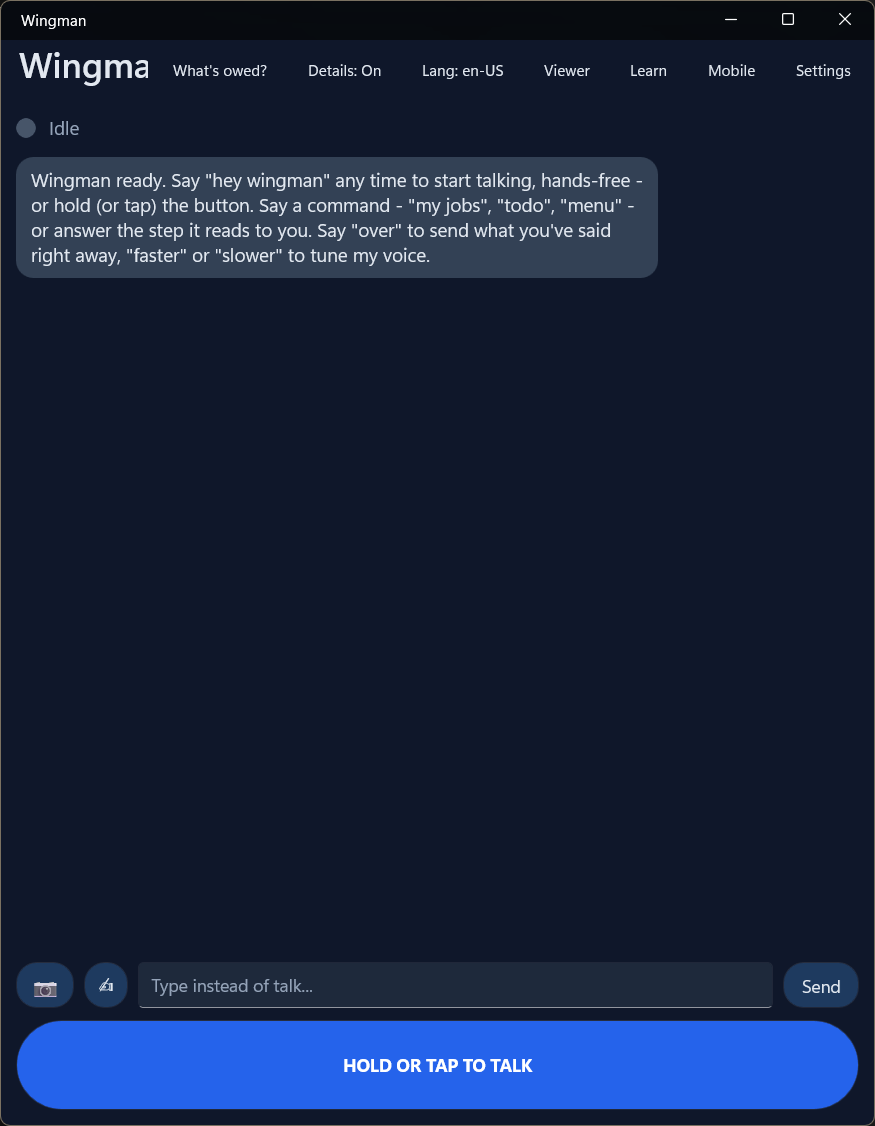
Voice in, structured answers out
The whole idea
Everyone else sells the pipe. This is the thing that runs in it.
Message delivery is a commodity and has been for a decade. What has never existed is a workflow engine on the other end of it — so the conversation does real work, returns real data, and fires real events in the systems you already run.
Go deeper
Three pages worth your next ten minutes.
Build it yourself ›
The builder, the API and the AI path — three ways in, one engine underneath.
Every channel ›
Write once, render native. What each channel can do, and what happens when one cannot.
See it running ›
Real screenshots and video from real threads — not a mock-up reel.
Start free
Bring the idea. We already did the hard part.
A PDF, a flowchart, or one sentence. Free sandbox, a real tenant, publishing to a real handset the first day.